1.An electromagnet which is connected to a controller and causes the opening and closing of automatic control valves.
2.An electromagnet which is connected to a controller and causes the opening and closing of automatic control valves.
In physics, the term solenoid refers to a long, thin loop of wire, often wrapped around a metallic core, which produces a magnetic field when an electric current is passed through it. Solenoids are important because they can create controlled magnetic fields and can be used as electromagnets.
How does a solenoid valve work?
A solenoid valve consists of two main components: a solenoid and a valve body (G). Figure 2 shows the components. A solenoid has an electromagnetically inductive coil (A) around an iron core at the center called the plunger (E). At rest, it can be normally open (NO) or normally closed (NC). In the de-energized state, a normally open valve is open and a normally closed valve is closed. When current flows through the solenoid, the coil is energized and creates a magnetic field. This creates a magnetic attraction with the plunger, moving it and overcoming the spring (D) force. If the valve is normally closed, the plunger is lifted so that the seal (F) opens the orifice and allows the flow of the media through the valve. If the valve is normally open, the plunger moves downward so that the seal (F) blocks the orifice and stops the flow of the media through the valve. The shading ring (C) prevents vibration and humming in AC coils.
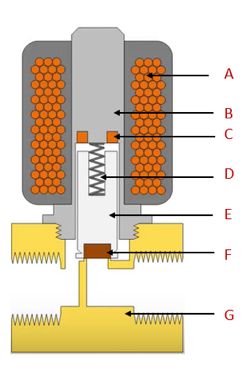
Figure 2: Components of a solenoid valve; coil (A); armature (B); shading ring (C); spring (D); plunger (E); seal (F); valve body (G)